فرہنگِ تلفظ کا تحقیقی و لسانی جائزہ
فرہنگِ تلفظ کا تحقیقی و لسانی جائزہ
پک اپ کی دستیابی لوڈ نہیں ہو سکی۔
A Research and Linguistic Review of Farhang-e-Talaffuz:
Rediscovery of Critical Consciousness and Protection of Linguistic Standards in Urdu Lexicography
Written by: Sheikh Abdul Rashid
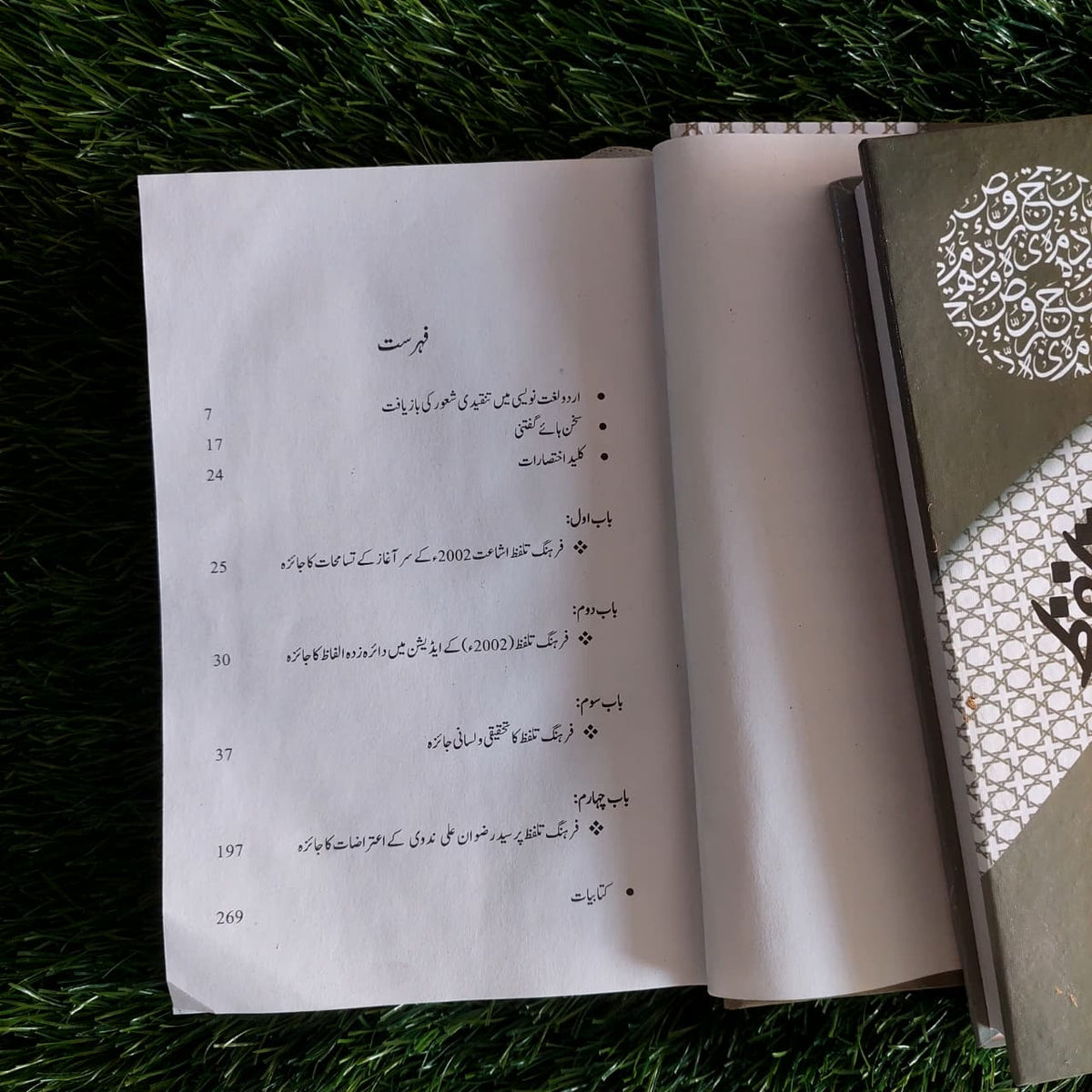
Lexicography serves as the backbone of the Urdu language's linguistic identity, phonetic order, and cultural evolution. The academic survival of any living language depends on how authentic and scientific its lexicographical and phonetic principles are. In this context, "Farhang-e-Talaffuz," compiled by Shan-ul-Haq Haqqee, is a document considered a milestone in authentic Urdu lexicography. By correcting the flaws in the phonetic system and symbols of the twenty-two-volume "Urdu Lughat (Tareekhi Usool Par)," Haqqee Sahib introduced a modern, coherent, and practical phonetic alphabet, which was a major linguistic discovery of its time. However, language compilation is a continuous process that requires renewal and critical insight over time. Renowned linguist Daniel Jones rightly said, "A dictionary is the guardian of a language's standard, and phonetics is its soul." In accordance with this scholarly requirement, the book "Farhang-e-Talaffuz ka Tehqeeqi o Lisani Jaiza" by Professor Muhammad Umar Khan, former professor of the Urdu Department at Government College Sahiwal, published by Fiction House Lahore, is not only a significant addition to the history of Urdu lexicography but also an important step toward the renaissance of the academic and literary prestige of the former Government College Montgomery/Sahiwal.
This book is not merely a commentary on a dictionary, but an objective and rigorous academic tool for evaluating Urdu's lexicographical and linguistic standards. Hafiz Safwan Muhammad has expressed a highly insightful opinion about this scholarly endeavor on the book's back flap. To him, this book is evidence that Rana Muhammad Umar Khan has put immense effort into this work. Had Mr. Haqqee seen it, he would have been overjoyed to see his lost copy of Farhang-e-Talaffuz in a tangible form. Professor Rafeeq Zaheer has written an erudite introduction to this book, and while highly praising this endeavor, he has introduced the reader to the various levels of foundation-laying for this work.
Undoubtedly, the way Professor Muhammad Umar Khan has examined the complex linguistic debates of "Farhang-e-Talaffuz" on scientific and research-based foundations holds the status of an authoritative reference in the history of lexicography. Studying Haqqee Sahib's "Farhang-e-Talaffuz," the reality becomes clear that he worked tirelessly to establish Urdu's phonetic structure on scientific principles. However, after the printing of the first edition in this scholarly journey, the scribe could not fully implement Haqqee Sahib's own corrections and proofreading fixes. This incomplete work kept the standard of Urdu lexicography in a state of vacuum for a long time, which partially harmed the phonetic temperament of the language. Therefore, to fill this academic gap, the broad-mindedness and attention to detail demonstrated by Professor Rana Muhammad Umar Khan are commendable. Rana Sahib is not just a researcher but a pulse-reader of lexicography. His research efforts and scholarly insight had already been acknowledged by Dr. Shamsur Rahman Faruqi's critique of "Lughat-e-Rozmarra." In "Farhang-e-Talaffuz ka Tehqeeqi o Lisani Jaiza," he has presented a comparative study of the various editions of Haqqee Sahib's dictionary, especially the publication journey from 1995 to 2022. According to the principles of modern lexicography, as Samuel Johnson stated, "The purpose of dictionaries is the correction and perfection of language," this effort by Rana Sahib is a practical interpretation of that golden principle. Lexicography is not merely a literary taste but an extremely precise and technical process; the diligence shown by our lexicographers in an era when modern phonetic tools and software did not exist, with their limited resources, is a bright example for researchers of today's digital age. It was this lack of technical expertise that left the dictionary flawed in many places.
An important critical aspect of the book emerges in the review of the 2002 edition, where the author, in the context of the objections raised by Syed Rizwan Ali Nadvi, has engaged in an exhaustive discussion on the diacritics and meanings of words such as 'Kunj', 'Abaq', 'Imlas', 'Picket', and 'Takhbeer'. Rana Sahib has pointed out that lexicographers, in many places, adopted a cursory attitude instead of historical principles. For example, the contradiction found in the entry of the birth and death years of Aristotle is the result of the conflict between the right-to-left and left-to-right writing principles of English and Urdu scripts. The author has proven that the prevalent method of entering BC dates has caused academic errors in Urdu lexicography, which require immediate correction.
The thoughts of observers align with the work of Rana Umar Sahib at the point where they say, "Objective study is the only path in linguistic research that leads us to the truth." Muhammad Umar Sahib has termed the absence of phonetic symbols, such as Fatha, Kasra, and Damma, in the 2017 Nastaleeq edition as a major deficiency for the phonetic beauty of the language. He does not just point out errors but also traces their historical and linguistic roots. The comparative analysis he has presented of the scholarly debate between Syed Rizwan Ali Nadvi and Haqqee Sahib promotes a healthy tradition of dialogue in Urdu research. According to Noam Chomsky, "The study of the structure of language is associated with its deep phonetic and psychological system." Under this principle, Rana Sahib has re-examined the linguistic structure of Haqqee Sahib's dictionary.
This book is not just a research effort but a charter of reform for Urdu lexicography that provides guiding principles for future researchers. The international status of Urdu demands that our dictionaries be standard and authentic. If we compromise on the phonetic system and accuracy of our dictionaries, how will scholars researching globally be able to trust the vocabulary and nuances of our language? Therefore, Umar Khan Sahib's work is also important in the sense that it helps in molding Urdu's academic identity according to global standards. Through this work, Rana Sahib has made it clear that a dictionary is not just a list of words, but a custodian of a living linguistic tradition. By reviewing the standard and importance of this work, it can rightfully be emphasized that such research efforts should be included at the curricular and research levels so that students can become aware of the basic requirements of lexicography.
This research journey will determine its own place in the history of linguistics because this work stands on solid academic foundations, rising above emotional gratification. Every page of the book is a mirror of the author's hard work, breadth of study, and linguistic precision. The way Rana Muhammad Umar Khan has covered the efforts made to remove the editorial and linguistic errors of this dictionary is not only an important aspect of history but also a warning for future researchers about the high price that even a little negligence in language compilation can exact. This work of Rana Sahib will prove to be a fundamental and indispensable reference for Urdu linguistics in the coming eras. This writing is undoubtedly an effort to keep alive the academic identity of Urdu, which is the hallmark of our civilization. Finally, it is essential to acknowledge that such serious academic and linguistic efforts are what strengthen a language and keep it moving on the path of evolution. If we do not correct our dictionaries today, the future generations will be in such a darkness regarding phonetic and lexical aspects from which there will be no return. Therefore, this effort by Rana Muhammad Umar Khan is not only an academic achievement but also a national linguistic duty that every writer must read and understand.
شیئر کریں