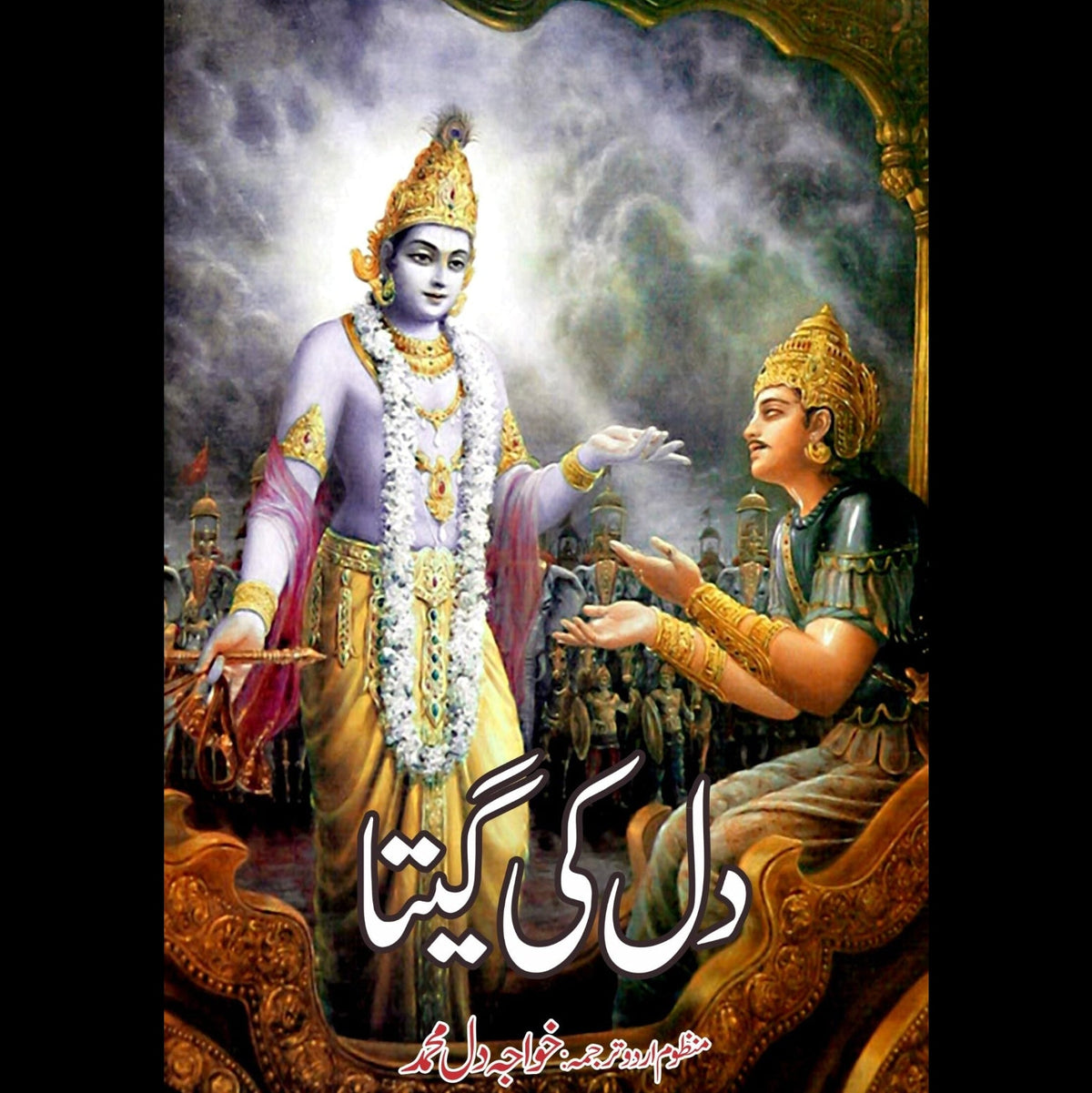
دل کی گیتا
دل کی گیتا
پک اپ کی دستیابی لوڈ نہیں ہو سکی۔
Author: Introduction
Khawaja Dil Muhammad belonged to a Sheikh family whose ancestor embraced Islam during the reign of Sultan Mahmud Ghaznavi. His ancestral home was Ghazni. His later ancestors settled in Lahore. The family's profession was trade. Facing the vicissitudes of time and revolutionary changes, this family continued to progress in every era. Khawaja Dil Muhammad was born in February 1883 in Kocha "Gian," behind Kashmiri Bazaar, Lahore, at the house of Khawaja Nizamuddin, son of Khawaja Noor Muhammad. He began his Quranic education at the age of four at Sunehri Masjid. After completing Nazra recitation, he was admitted to Islamia High School, Sheranwala Gate, and received his education up to matriculation from this school. During this period, the Anjuman-e-Himayat-e-Islam also established a college in the upper portion of the Islamia High School building. Consequently, Khawaja Dil Muhammad passed his FA and BA examinations from Islamia College itself. During his college days, Sheikh Sir Abdul Qadir was one of his teachers, and his personality left a deep impact on Khawaja Dil Muhammad. Khawaja Dil Muhammad had a natural affinity and interest in the subject of mathematics. In his Bachelors, his subjects included a double course in mathematics, and he later chose this same subject for his Masters, passing his Masters examination in mathematics in 1907. Thereafter, he was appointed as a teacher at Islamia College itself. His devotion to the college was profound. At various times, he was offered jobs with lucrative salaries, but Khawaja Sahib always decided in favor of Islamia College, continuing to quench the thirst of knowledge seekers at this college for 35 years. He became the Principal of this college in 1940 and retired in 1943. After retirement, he was appointed as Registrar of Lahore District. In 1946, at the time of the partition of India, he stepped down from this position due to poor health. During this period of employment, he remained engaged in authorship and compilation as well. As a teacher, Khawaja Dil Muhammad was very successful and popular. His knowledge and experience were very vast. He used to teach such a dry subject as mathematics in such an interesting manner that students would come to class with enthusiasm and leave happy and satisfied. His status as a mathematician was well-established, and mathematicians of his caliber could be counted on one's fingers. His prominent students include Sheikh Abdullah (former Chief Minister of occupied Kashmir state), Abdul Hamid Salik, Maulana Ghulam Rasul Mehar, Professor Taj Muhammad Khayal (first Chairman of the Board of Secondary Education), and Sheikh Zahid Hussain (former Governor of the State Bank). Khawaja Dil had a God-gifted talent for mathematics and poetry. He began his poetry with Naat-goi (writing Naats). In 1902, when he was an FA student, his father had a collection of his early poetic works published under the title "Hamd-o-Naat," but no copy of it is available now. The formal beginning of Khawaja Dil Muhammad's poetry came with national poems at the annual sessions of the Anjuman-e-Himayat-e-Islam. During his student days, Khawaja Sahib used to recite poems at these sessions where senior poets like Hali, Shibli, Deputy Nazir Ahmed, and Arshad Gurgani would recite their poems. Khawaja Dil Muhammad would both receive praise and benefit from these great personalities. God had blessed him with a sound mind. Therefore, by benefiting from the works of Hali, Arshad Gurgani, Sail Dehlvi, and Allama Iqbal, he nurtured his poetry. Inspired by the works of Maulana Hali and Iqbal, he recited excellent poems at the annual sessions of the Anjuman. The collection of poems recited at these annual sessions was quite voluminous. Consequently, later on, Khawaja Sahib pruned the poems in this collection and republished it in 1956 under the title "Hayat-e-Nau." The scope of Khawaja Dil Muhammad's political and social services is very vast; despite the constraints of his employment, he participated in national and political movements. In 1924, he participated in the Municipal Committee elections on the ticket of the joint committee of Khilafat and Congress and continued to help Muslims in every way possible, and through his poetry, besides fulfilling the duty of protecting the ideological borders of his country, Pakistan, he also instilled a sense of freedom and enthusiasm among the Muslims. This couplet from the poem "Muhammad bin Qasim Fateh-e-Pakistan," recited at the 1938 session of the Anjuman-e-Himayat-e-Islam, is a rich reflection of his sentiments: "Unite the Punjab, Sindh, Sarhad, and Kashmir / O pure servant of God, create your own Pakistan" (The name 'Pakistan' was proposed by Chaudhry Rahmat Ali). Mathematics, being a difficult and dry subject, has always been a burden for students, but Khawaja Dil Muhammad adopted such a lively and attractive style in teaching it that those who were averse to mathematics became its admirers. In 1924, he presented a simple solution to the complexities of Algebra through his writing. This Algebra became extremely popular and was printed and sold in thousands. Due to its tremendous popularity, he authored two more books the following year. The set of all three books was completed in 1935. These three books became prevalent in every school. So much so that these books were also approved in the curricula of Aligarh University, Bombay, and Madras University. The style of Geometry was so well-liked that this book started being taught in Hindu schools as well. Before these books, books by Hindu and English authors were prevalent in the Islamia schools of the Anjuman-e-Himayat-e-Islam, but after the publication of these works by Khawaja Dil Muhammad, these books began to be taught. One year after the establishment of Pakistan, Khawaja Dil Muhammad translated this famous series from English to Urdu for Pakistani educational institutions. This was the first standard series of textbooks in Urdu, which was well-received and grabbed instantly. 32 mathematics books compiled by Khawaja Dil Muhammad remained part of the curricula of various levels. Khawaja Dil Muhammad also participated in preparing the curriculum for the higher classes of Punjab University, Lahore. He remained a member of the Punjab University Syndicate for eleven years and a Fellow of Punjab University for 24 years. He remained a Trustee of the Lahore Improvement Trust for six years. Khawaja Sahib spent his entire life in knowledge, literature, and social services. He passed away on 28 May 1961 due to cancer.. -
شیئر کریں